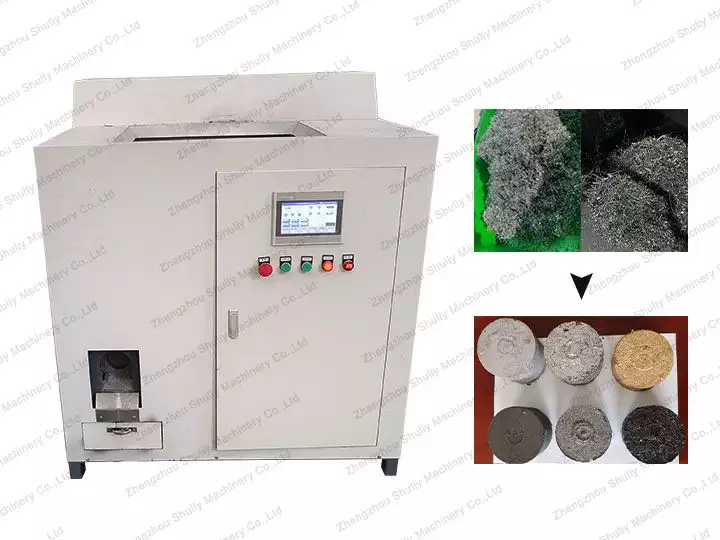
Vertical vs Horizontal Baler: Which Fits Your Operation?
Ask ten recycling operators which baler they wish they had bought and at least five will say: the other orientation. The difference between vertical and horizontal balers isn’t just which way the ram points—it changes how you load material, how you tie bales, how many people the machine needs, how much floor space it takes, and how fast your stock moves out the door.
The short answer: a vertical baler fits sites with modest daily volume, limited space, and staff who can load and tie by hand; a horizontal baler fits operations where volume, automation, and continuous feeding decide your margins.
The rest of this guide shows exactly how to get from that one-sentence rule to a machine specification — in five steps. If you already know your material and daily tonnage, jump to the quote section, and we’ll size it with you.
Vertical vs Horizontal Baler: Side-by-Side Comparison
| Factor | Baler ya Wima | Baler ya Mlalo |
|---|---|---|
| Ram / bale direction | Vertical press, bale forms upward | Horizontal press, bale forms along the chamber |
| Inapakia | Manual or hopper feed into the front opening | Continuous feed — conveyor, hopper, or large bin |
| Bale tying | Manual wire tying by the operator | Automatic wire or strapping cycles (auto-trip) |
| Throughput level | Low to medium — sized per shift, not per hour | Medium to high — built for continuous volume |
| Floor space | Compact footprint, single operator station | Larger footprint: chamber plus in/outfeed lanes |
| Labor per bale | Higher — loading and tying are hands-on | Lower — one attendant supervises the cycle |
| Bale handling | Bales drop at waist height, easy to remove in small sites | Bales exit onto a line or press cart for bulk handling |
| Best-fit users | Shops, small depots, restaurants, warehouses, startup yards | Scrap yards, MRFs, paper mills, high-volume collectors |
What a Vertical Baler Does Best
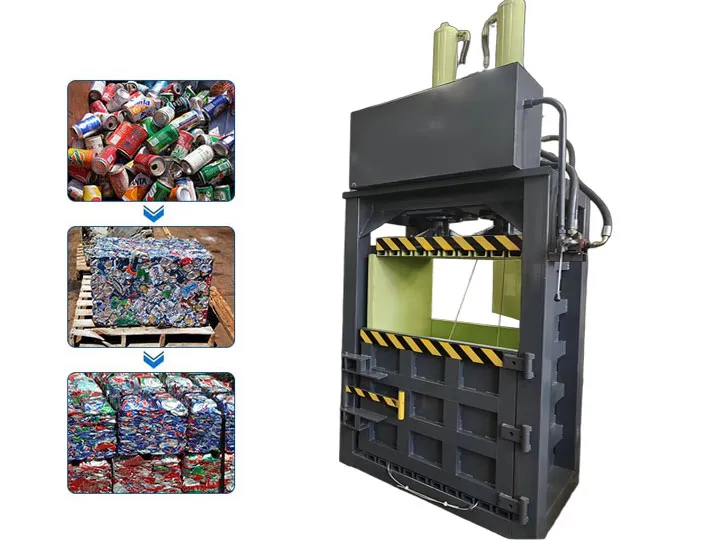
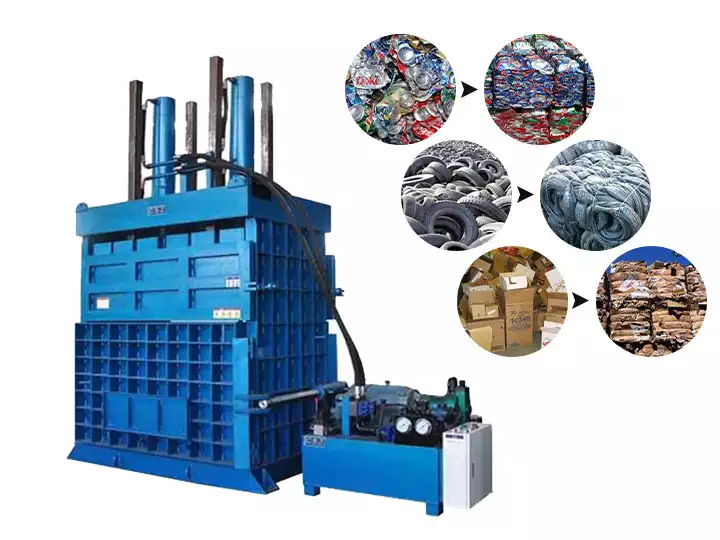
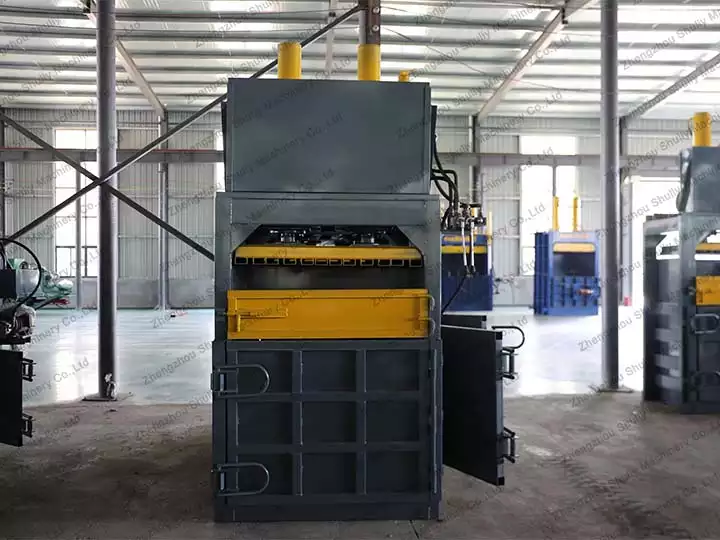
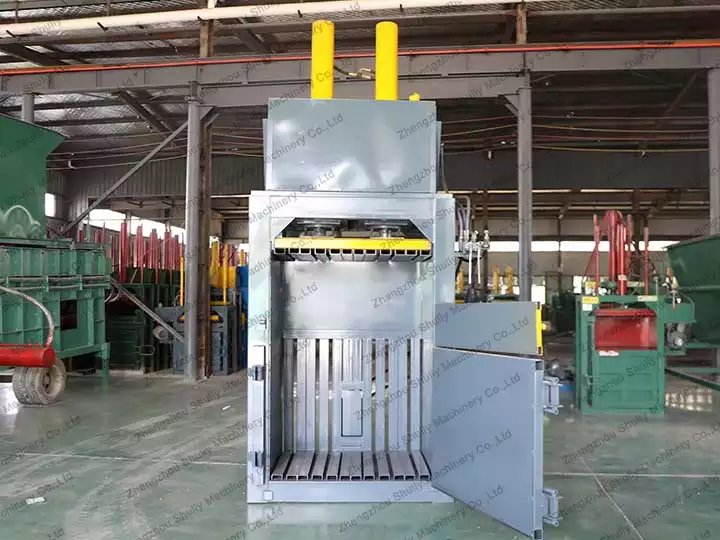
A baler wima presses material upward in a vertical chamber. Its strengths are exactly what small and mid-size sites pay for:
- Alama ya kompakt — the machine occupies a single operator station, so it fits in back rooms, corner yards, and containers.
- Lower entry cost — simpler structure and manual tying make verticals the practical first machine for startups.
- Flexible material switching — the open chamber takes cardboard, PET bottles, cans, and light metals without reconfiguration. Our wima kadibodi baler na alumini unaweza baler are both vertical designs.
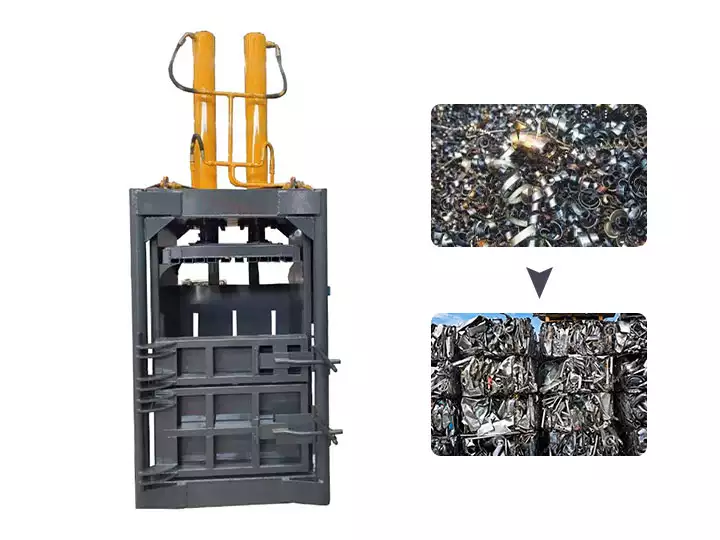
- Full-size bales for metal — a vertical metal baler compresses scrap steel, copper, and aluminum into dense blocks that smelters and traders accept at good rates.
The limits: every bale needs an operator to load and tie it, so human cycle time caps throughput. When daily volume climbs past what one or two shifts can feed, the vertical becomes the bottleneck — not because it is weak, but because it is manual at the core. See our deeper look at the role of vertical waste balers in the recycling industry.
What a Horizontal Baler Does Best
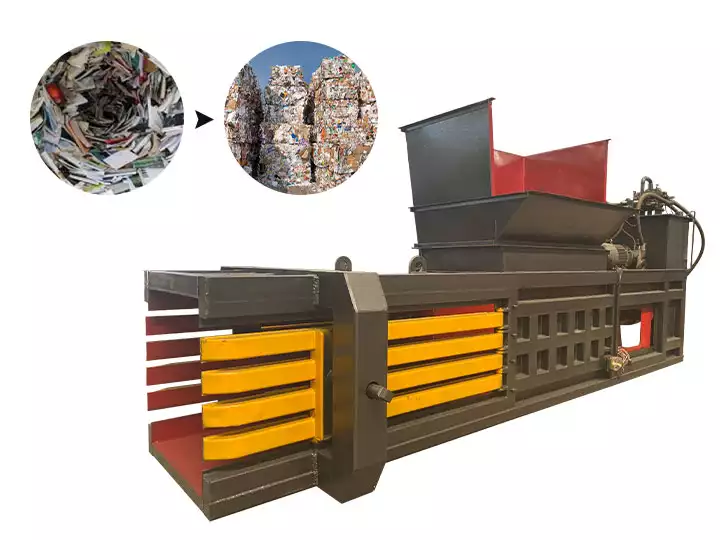
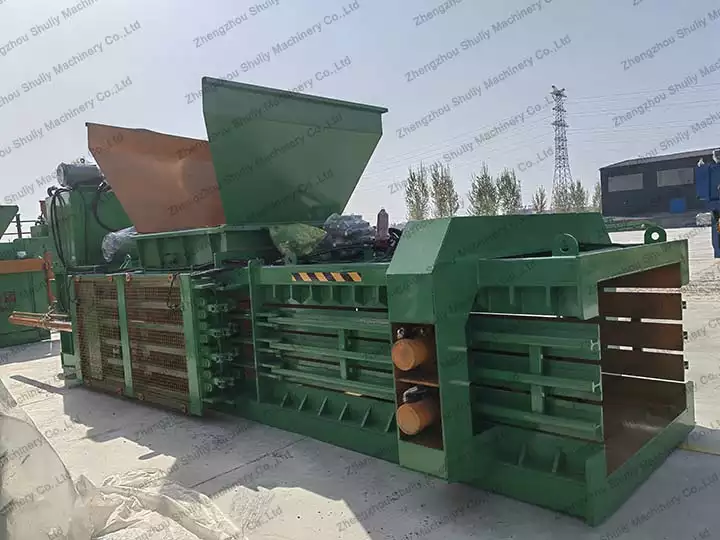
A baler ya usawa compresses material along a horizontal chamber and — in semi- and fully-automatic models — ties each bale on an auto-trip cycle the moment pressure is reached. That single automation changes the economics:
- Continuous feeding — material goes in while the machine cycles; no waiting between bales. On a mashine ya kubandika karatasi taka this is what turns a pile of loose OCC into truck-ready bales within the same shift.
- Higher throughput per labor hour — one attendant supervises what would take a small crew on a vertical line.
- Uniform, dense bales — automatic tie pressure and cycle consistency produce bales that weigh-in predictably, which matters when you sell by the ton.
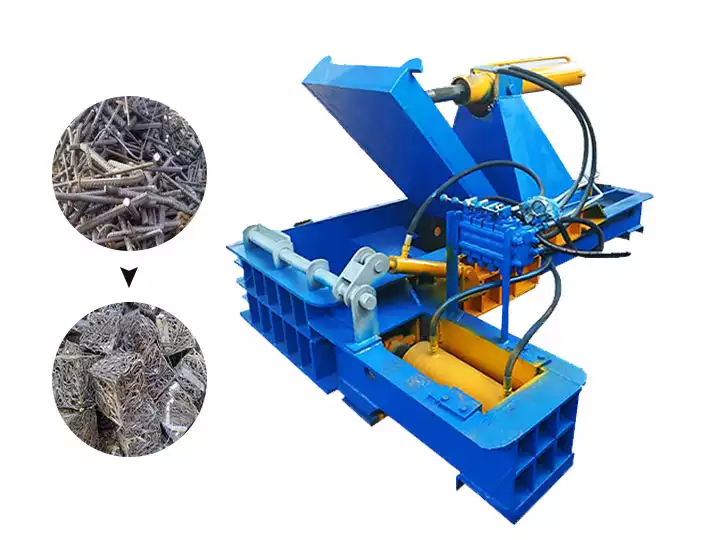
- Heavy scrap capability — high-tonnage horizontal scrap metal balers handle ferrous and non-ferrous scrap at rates verticals cannot match, with cylindrical, rectangular, or multi-prism bale shapes.
The limits: bigger footprint, higher investment, and a feed system that wants a steady material stream. A horizontal machine idling at 20% utilization is a wasted budget — which is why the volume check in Step 2 below matters so much. For the buying factors specific to metal work, our separate article covers what to weigh when buying a horizontal metal baler.
The 5-Step Decision Framework
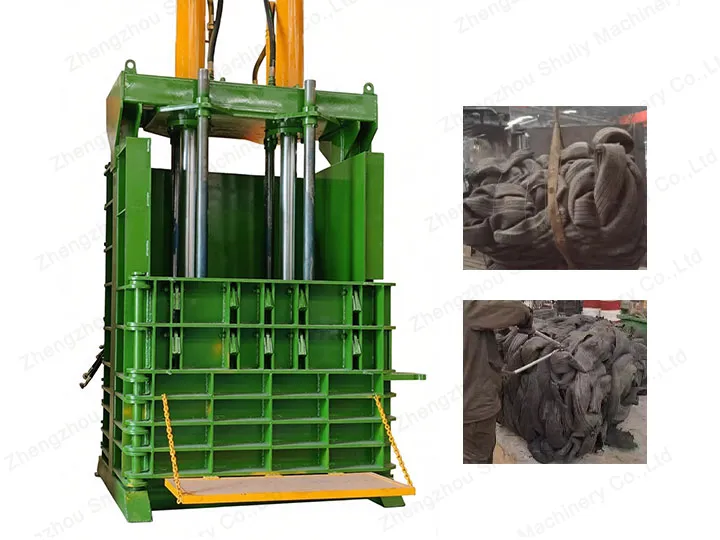
- Step 1 — Material. Cardboard, film plastic, PET bottles, and light waste work on either orientation. Dense or bulky metal scrap points to a vertical metal baler at small scale, horizontal at large scale. Tires, drums, and hay each have purpose-built chambers — check the machine page before assuming.
- Step 2 — Daily volume. The single strongest predictor. If your team can load and tie everything within the shift without a queue, a vertical is enough. If loose material already piles up faster than bales come out, you need horizontal throughput.
- Step 3 — Floor space. Measure the bay, not the machine. A vertical fits where a truck can still turn; a horizontal needs chamber length plus infeed and outfeed lanes. Low door heights also favor verticals.
- Step 4 — Labor pattern. Vertical = baling is a job someone does. Horizontal = baling is a line someone supervises. If trained hands are scarce or shifts are long, automation pays for itself in labor you do not have to hire.
- Step 5 — Growth plan. Buying a vertical for volume you will double in a year means buying twice. If your contracts are growing, size the horizontal now — or start with a vertical and keep it as a pre-processing station beside the next machine.
Cost Structure: Why Horizontal Balers Cost More
Across the market, horizontal balers sit above verticals on price — and the reason is structural, not brand markup: a longer fabricated chamber, auto-wire binding heads, PLC control, feed conveyors, and higher-tonnage hydraulics are all components a vertical simply does not carry. Within each orientation, price then scales with press force, chamber size, and automation level.
Compare the two machines the way recyclers actually do: cost per ton baled, not sticker price. A vertical with cheap entry and a tying operator every cycle can cost more per ton than a horizontal that runs two attendants across triple the volume.
We quote both orientations by model and tonnage on request — send us your material and volume and we will show the per-ton math for your site instead of generic price lists.
Real Orders, Real Choices
Two recent Shuliy orders show the framework working in practice:
- Brazil — 10 sets of vertical metal balers. A scrap operation scaling across multiple collection points chose verticals because each site handled modest daily metal volume with one worker on site. Ten machines covered ten small yards — the economics of distributed collection, not peak throughput. Read the order case.
- Vietnam — horizontal paper baler line. A high-volume paper and cardboard processor needed continuous feeding and auto-tied bales to keep stock moving out by the truckload — exactly the Step 2 signal that rules a vertical out. Read the order case.
Same company, same industry, opposite orientations — because the deciding variable was volume pattern, not machine preference. That is the lesson: the right baler is a function of your flow, not of the catalog.
Not Sure Which Orientation Fits? Send Us Your Numbers
To recommend between a vertical and a horizontal baler, we need five things — the same five steps above in data form:
- Material type(s): cardboard, PET, cans, mixed paper, or specific metals
- Daily or weekly volume (weight or approximate bin count)
- Available floor space and door height
- How many staff can be assigned to baling per shift
- Local voltage (50 or 60 Hz, single/two/three-phase)
We will reply within 24 hours with an orientation recommendation, model options in both styles, and FOB/CIF pricing — including the cost-per-ton comparison from Step 5 of the budget section.