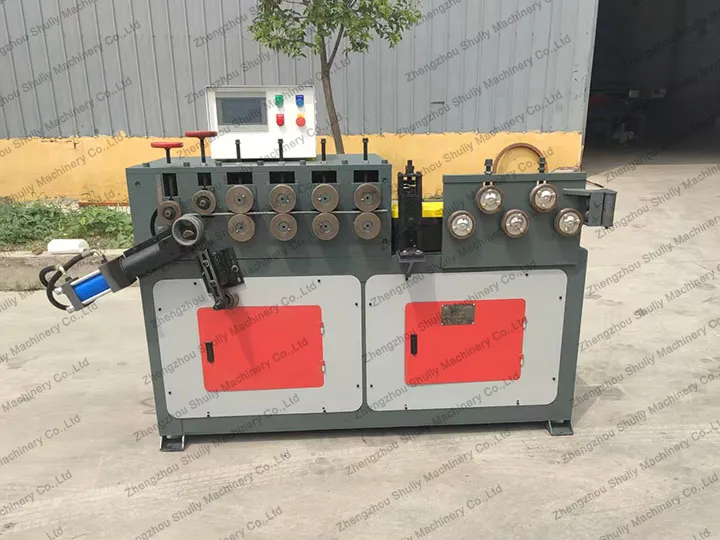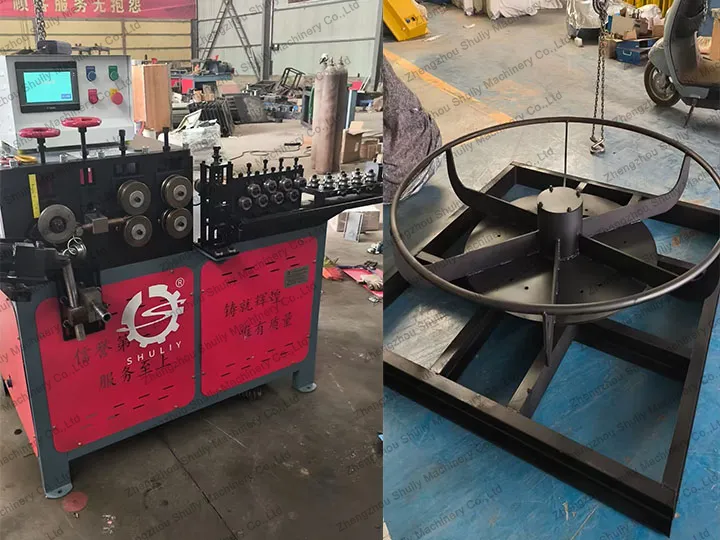
Rebar Cutting Machine
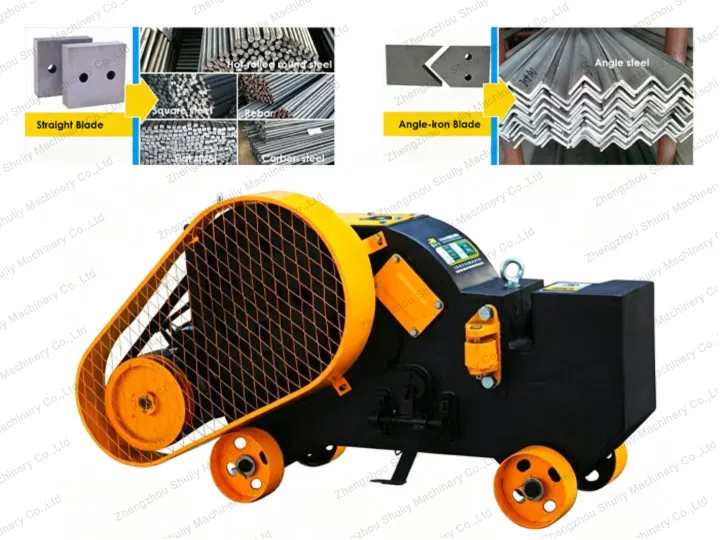
Steel Bar Cutting Machine | Heavy-Duty Rebar Cutter
Modelo: GQ Series
Cutting speed: 32 cuts/min continuous cycle
Cutting range: 4-50 mm rebar
Cutting materials: Rebar, threaded rebar, round bar, and angle iron
Tensão de entrada: 3-phase 380V / 50Hz (220V/415V/480V optional)
Drive: Flywheel + single-plate clutch + cam-actuated blade
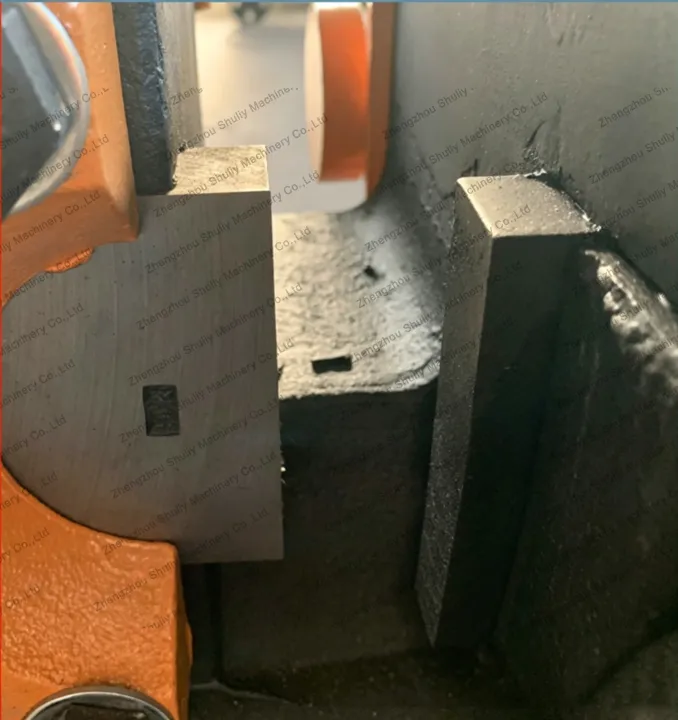
Lâmina: Cr12MoV tool steel, HRC 58-62, 26 mm thickness
Operation: Manual feed + foot-pedal cycle start
Mounting: Free-standing on level concrete; GQ60 requires four M16 anchor bolts
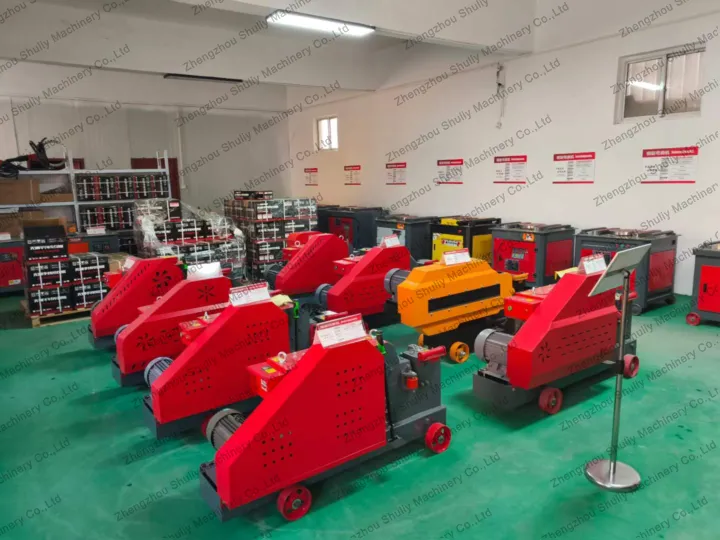
Shuliy rebar cutting machine is a high-torque mechanical shearing tool that cuts rebar, threaded rebar, round bar, and angle iron to specified lengths. Marketed under several names—steel bar cutter, rebar cutter machine, heavy-duty rebar cutter—it serves both site work and rebar processing plants.
Our GQ series ships in 8 variants covering 4-50 mm rebar e 30×30-80×80 mm angle iron, all running at 32 cuts per minute on 3-phase 380V power. The flywheel-and-clutch drive eliminates hydraulic complexity, making this an industrial rebar cutter machine that is lower-maintenance than hydraulic rebar cutters and CNC automatic ones of similar capacity.
This pillar guide covers the 8 GQ models, three design features that set them apart from low-cost steel bar cutters, compatible materials, applications, and pricing.
Whether you need a basic electric rebar cutter for site work, a 50 mm heavy-duty rebar cutter for bored piles, a straight-thread steel bar cutting machine for splice systems, or an angle iron cutting machine for structural steel fabrication, the sections below provide the data to choose.
Why Construction Sites and Rebar Plants Choose a Mechanical Rebar Cutter
Standard rebar cutting machines handle two core jobs: cutting rebar to length on the job site, and pre-cutting stock for stirrup, cage, and pile cap production in a rebar processing plant. The GQ series—also called a rebar cutter, round bar cutting machine, or angle steel cutter—handles both:
- On-site rebar cutting for 6-32 mm bar in beam, column, and slab work
- Plant pre-cutting feeding a Máquina de alisamento de vergalhão ou rebar arc bending machine line with 6-12 m stock cut into 1-2 m sections
- Threaded rebar cutting for mechanical splice coupling
- Bridge and tunnel stock pre-cutting for 32-50 mm rebar used in bored pile and diaphragm wall cages
- Angle iron and channel steel cutting via the GQ40 Angle Iron variant, which handles 30×30-80×80 mm angle at 32 cuts/min
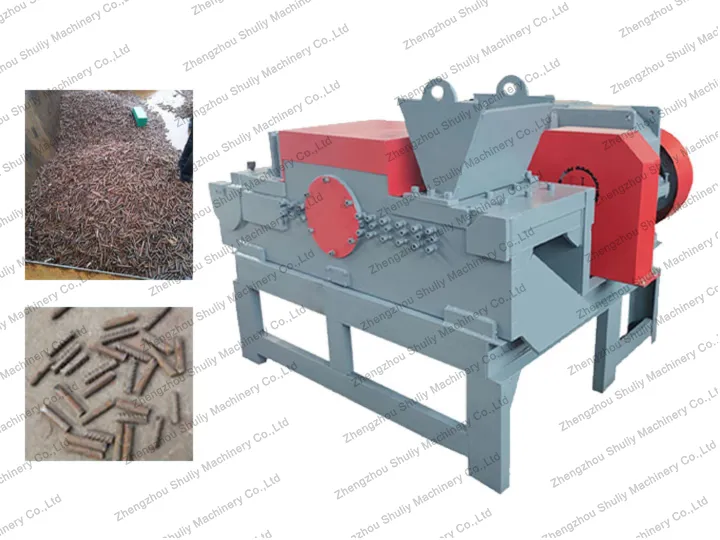
- Scrap yard reduction cutting 1-6 m scrap rebar to 0.5-1 m lengths before scrap rebar granulator or baler feed
All 8 GQ models share three design features that separate them from low-cost steel bar cutters:
- 26 mm-thick, high-strength blade: Cr12MoV tool steel, through-hardened to HRC 58-62. The extra thickness lets one stroke shear multiple bars at once (e.g., 3× 12 mm or 2× 16 mm), halving cycle time versus single-bar rebar cutters.
- Enlarged, thickened flywheel: The flywheel stores motor energy and releases it in a single shearing stroke. Mass is matched to motor output—2.2 kW for GQ40, 3 kW for GQ42/GQ45, 4 kW for GQ50, and 5.5 kW for GQ60. Cutting 32-50 mm rebar becomes effortless: the operator presses the foot pedal, the clutch engages, and the flywheel delivers full cutting force in under 0.5 seconds.
- New-style spring mount: A compression spring on the cutting arm absorbs inertial impact when the blade strikes the rebar. This keeps the cut face flat (no bent ends), extends blade life 30-50% over rigid-arm designs, and reduces operator fatigue on long shifts. A rigid-arm steel bar cutter cracks blades within 6 months on 32 mm rebar; the spring-mounted design runs 12+ months on the same workload.
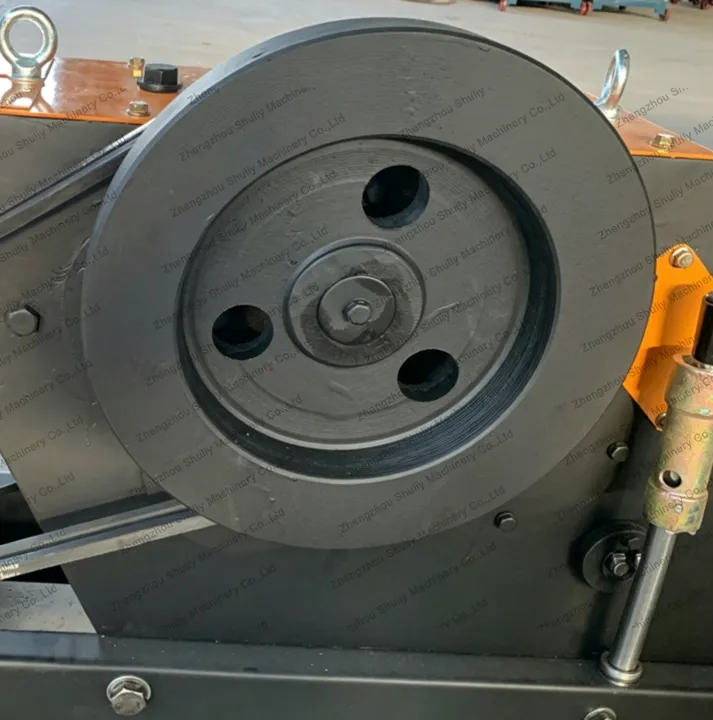
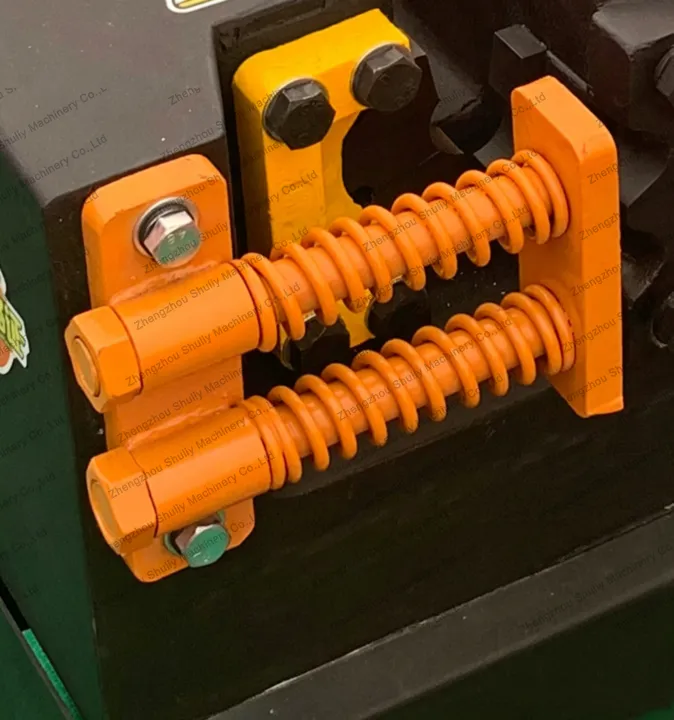
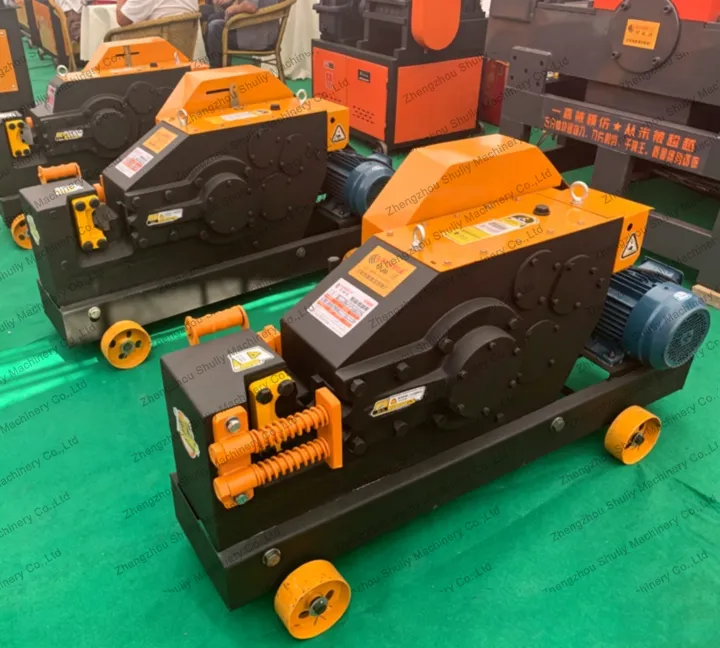
GQ Series Rebar Cutting Machine Specifications (8 Models)
All 8 GQ variants are listed below. Each runs at 32 cuts per minute on 3-phase 380V power and shares the same flywheel-clutch platform.
| Modelo | Round Bar Max | Rebar (Threaded) Max | Motor Power | Size (mm) | Peso | Notas |
| GQ40 (Angle Iron) | — | — | 2.2 kW | 1150×450×500 | 280 kg | Angle iron 30×30-80×80 mm; blade 83×83×16 mm |
| GQ40 | ≤28 mm | ≤25 mm | 2.2 kW (national-standard copper) | 1150×450×500 | 280 kg | Standard site cutter |
| GQ42 | <36 mm | ≤32 mm | 3 kW | 1300×450×500 | 360 kg | Mid-size site/plant cutter |
| GQ45 (Heavy-Duty) | <36 mm | ≤32 mm | 3 kW | 1300×450×500 | 390 kg | 30 kg heavier than GQ42; reinforced body |
| GQ45 (Straight-Thread) | <36 mm | ≤36 mm (threaded) | 3 kW | 1300×450×500 | 410 kg | Special die for straight-thread rebar |
| GQ50 | <42 mm | ≤40 mm | 4 kW | 1450×450×550 | 510 kg | Heavy civil works cutter |
| GQ50 (Straight-Thread) | ≤42 mm | ≤40 mm (threaded) | 4 kW | 1450×450×550 | 530 kg | For threaded rebar splice systems |
| GQ60 (Heavy-Duty) | <55 mm | ≤50 mm | 5.5 kW (national-standard copper) | 1650×600×900 | 880 kg | Bored pile/diaphragm wall cutter |
Common Specifications (all 8 models):
- Cutting speed: 32 cuts/min continuous cycle
- Input voltage: 3-phase 380V / 50Hz (220V/415V/480V optional)
- Drive: Flywheel + single-plate clutch + cam-actuated blade
- Blade: Cr12MoV tool steel, HRC 58-62, 26 mm thickness
- Operation: Manual feed + foot-pedal cycle start
- Mounting: Free-standing on level concrete; GQ60 requires four M16 anchor bolts
Materials a Rebar Cutting Machine Can Process (Rebar, Round Bar, Angle Iron, Threaded Bar)
The GQ series also works as a cutting machine for round bar, angle iron, and deformed bar. It cuts five material categories used in construction and metal processing:
| Material Type | Diameter / Size Range | Common Grades | Recommended GQ Model |
| Round bar (mild steel) | ≤55 mm | Q235, SS400, A36 | GQ40-GQ60 by diameter |
| Deformed rebar (HRB) | ≤50 mm | HRB400, HRB500, B500B | GQ40-GQ60 by diameter |
| Threaded rebar (straight-thread splice) | ≤40 mm | PSB500, PSB785 | GQ45 or GQ50 straight-thread variant |
| Angle iron (equal-leg) | 30×30-80×80 mm | Q235, Q345 | GQ40 (Angle Iron) |
| Channel steel / flat bar | 30-80 mm width | Q235, Q345 | GQ50-GQ60 with optional die |
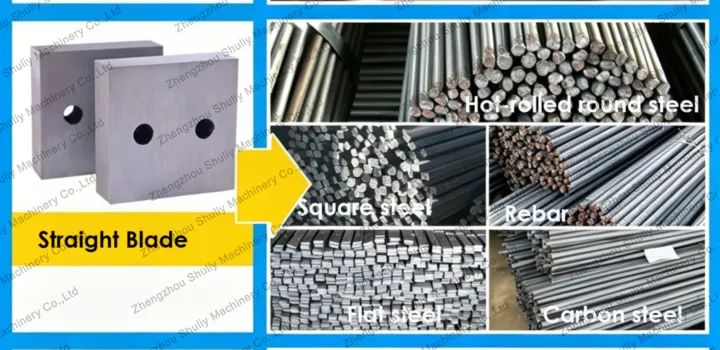
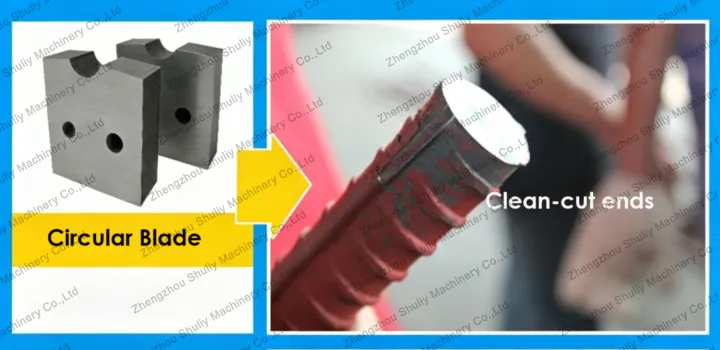
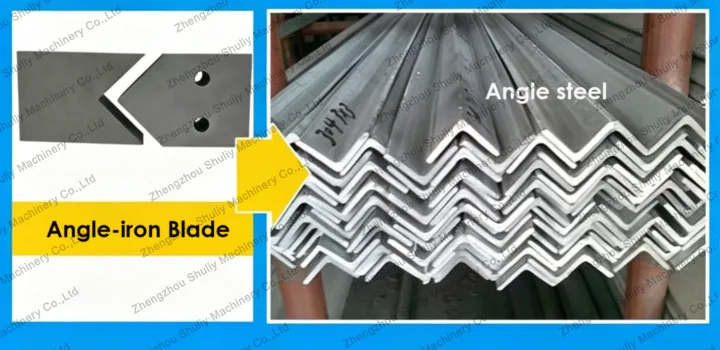
The flywheel-clutch design works best with solid bar stock and rebar. Thin-wall steel pipe (under 2 mm wall) may crush rather than shear cleanly; use a dedicated tube cutter instead. For threaded rebar splice systems, the GQ45 and GQ50 straight-thread variants use a custom die that grips the thread profile without stripping the ribs during cutting.
Common Applications of Steel Bar Cutting Machine for Construction
A rebar cutting machine appears on virtually every reinforced concrete project. Here are six common uses, matched to the right GQ model:
- High-rise site cutting: GQ40 or GQ42 sits beside the rebar arc bender on each floor. At 280-360 kg, two workers can move it; 32 cuts/min keeps pace with two benders.
- Bridge deck and pier prep: GQ45 or GQ50 with 32-40 mm capacity handles pier cage longitudinal bars and bridge deck transverse bars at 1,500-1,800 cuts per 8-hour shift.
- Bored pile and diaphragm wall cages: GQ60 heavy-duty cuts 50 mm rebar for pile cage hoops and main bars. The 880 kg, 5.5 kW unit is anchor-bolted to the foundation; common in metro and high-speed rail work.
- Threaded rebar splice lines: GQ45 or GQ50 straight-thread pre-cuts rebar to length before the threading machine—required for HRB500E seismic-grade splice systems in column and beam joints.
- Steel structure fabrication: GQ40 (Angle Iron) cuts braces, gusset plates, and connector plates at 32 cuts/min, replacing a bandsaw for 30×30-80×80 mm angle in many shops.
- Scrap yard sizing: GQ50 or GQ60 reduces 1-6 m scrap rebar to 0.5-1 m lengths before scrap rebar granulator feed or baler compaction—double the throughput of hand torching.
How to Choose the Right Rebar Cutter (Manual, Electric, Hydraulic, Automatic)
Four reabr cutter types compete in the same capacity range. The table below matches each to its best-fit use:
| Tipo | Drive | Capacidade | Peso | Best For | Trade-Off |
| Manual rebar cutter | Hand lever / hydraulic hand pump | ≤16 mm | 5-25 kg | Small jobs, no power | Slow; operator fatigue |
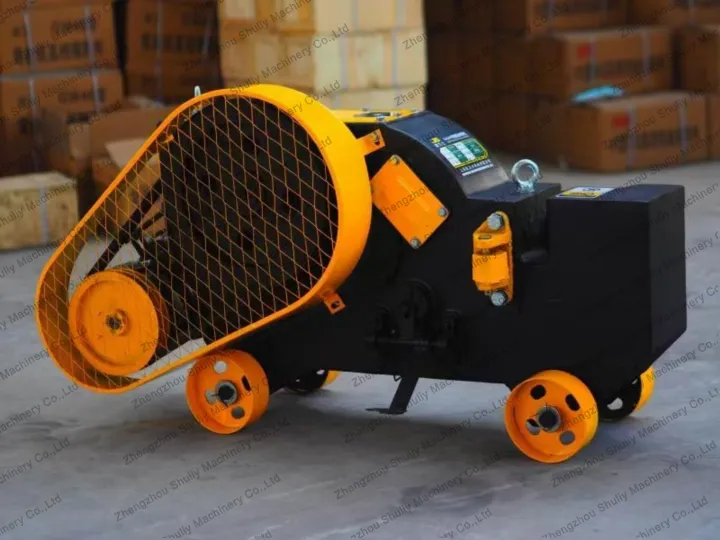
| Electric rebar cutter (GQ) | Flywheel + clutch + 2.2-5.5 kW motor | ≤50 mm rebar, ≤55 mm round, 80×80 angle | 280-880 kg | Sites, plants, scrap yards | Needs 3-phase power |
| Hydraulic rebar cutter | Hydraulic cylinder + pump | ≤32 mm portable, ≤50 mm stationary | 15-200 kg | Portable site work, low noise | Slower; hose maintenance |
| Automatic rebar cutting machine (CNC) | Servo feed + hydraulic shear | ≤16 mm typical | 500-2,000 kg | Mass-production stirrup lines | High cost; complex setup |
For 80% of construction and rebar processing buyers, the GQ series electric rebar cutter hits the best capacity-to-cost-to-maintenance balance.
Manual rebar cutters cap at 16 mm and exhaust operators within 2 hours.
Hydraulic rebar cutters are quieter and portable but typically cut 30-50% slower than the flywheel-driven GQ series.
Automatic rebar cutting machines only pay off above 5,000 cuts per day in a dedicated rebar plant.
Rebar Cutting Machine vs Rebar Shear: What Is the Difference?
Buyers often search for “rebar shear” or “rebar shears” interchangeably with “steel bar cutting machine.” They are different categories:
- Rebar cutting machine (GQ series): Precision cutter producing clean, square ends on rebar, threaded rebar, and round bar. Built for length accuracy in rebar processing—cuts 4-50 mm bar at 32 cuts/min.
- Rebar shear / hydraulic alligator shear: High-throughput rough cutter for scrap metal, demolition, and baler feed lines. Cuts 30-200 mm bar at 6-12 cuts/min and leaves variable-length, jagged ends.
Use a heavy-duty rebar cutter when cut length matters (e.g., 1,200 mm stirrup legs, threaded splice pre-cuts). Use a rebar shear when only rough downsizing matters (e.g., cutting 6 m scrap rebar to 1 m for a baler).
Rebar Cutting Machine Price Guide (Manual, Electric, Hydraulic Ranges)
Three price tiers cover the global construction rebar cutter machine for sale market:
- Manual rebar cutter (≤16 mm): USD 80-250. Hand lever or hydraulic hand pump. Used by small contractors and DIY.
- Electric rebar cutter / GQ series (4-50 mm): USD 450-3,200. The most popular range for sites, plants, and scrap yards. GQ40/GQ42 at USD 450-900, GQ45/GQ50 at USD 1,200-2,200, GQ60 at USD 2,500-3,200.
- Automatic CNC rebar cutting machine (≤16 mm, mass production): USD 8,000-25,000. Servo feed, programmable length, integrates with CNC rebar bender lines.
Price drivers: motor power, body weight (heavier = more cast iron = higher cost), blade material, voltage customization (220V civil variants add 5-8%), and packaging (plywood case vs. bare pack).
How to Operate a Rebar Cutting Machine Safely (5-Step SOP)
Standard operating procedure for the GQ series:
- Step 1 — Pre-start check: Confirm 380V 3-phase power, grounded outlet, gearbox oil level (if applicable), and blade gap (typically 0.5-1.0 mm for rebar under 25 mm). Confirm emergency stop functions correctly.
- Step 2 — Material positioning: Place rebar flat on the feed table against the length stop. For multiple-bar cuts, align bars within the rated diameter (e.g., 3× 12 mm for a GQ40 rated 25 mm).
- Step 3 — Cycle start: Press the foot pedal; the clutch engages and the flywheel delivers the cutting stroke in under 0.5 seconds. Keep both hands clear of the cutting zone.
- Step 4 — Cut inspection: Verify the cut end is flat (no bend or burr). A bent end signals a worn blade or wrong gap; a burr signals blade replacement is due.
- Step 5 — End-of-shift maintenance: Wipe the blade, lubricate the spring mount, check belt tension, and log the cut count. Replace the blade every 30,000-50,000 cuts depending on rebar grade.
Why Choose Shuliy Rebar Cutting Machine (Manufacturer & Supplier Direct)
Five reasons international buyers source their rebar cutter from Shuliy Factory directly:
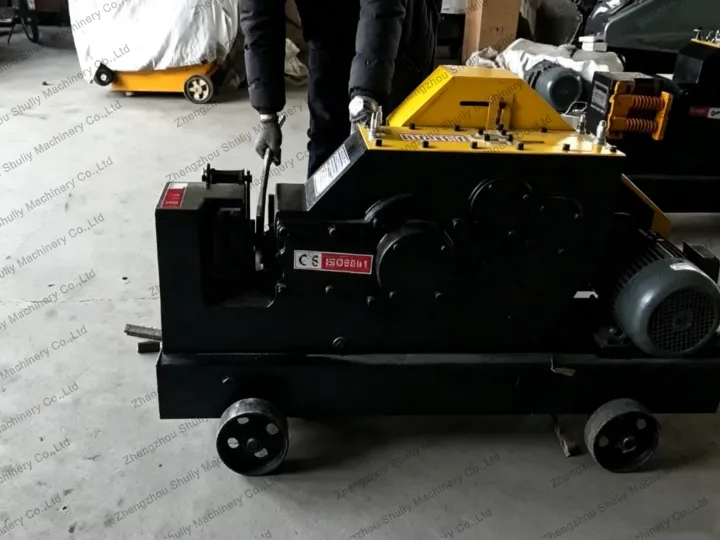
- National-standard copper-winding motors: Every GQ model ships with 100% copper windings (2.2-5.5 kW). Aluminum-winding motors are common in low-cost competitors and fail within 6 months on heavy cuts.
- Customizable voltage: 380V/50Hz standard; 220V/415V/480V/60Hz available at no extra cost for OEM orders of 5+ units. Critical for civil-market 220V regions and 60Hz markets in the Americas and Saudi Arabia.
- 2-year warranty: Covers motor, flywheel, blade, and gearbox. Wear parts (blade, spring) swap in 30 minutes with standard tools.
- FOB/CIF/DDP global shipping: The 280 kg GQ40 fits 24+ units in a 20GP container; the 880 kg GQ60 ships in 40HQ. We handle export documentation, CE certification, and commissioning videos.
- OEM / ODM / private label: Add your brand to the body, choose custom paint colors, and ship with a custom manual. MOQ 3 units for OEM.
Rebar Cutting Machine FAQ
What size rebar can a GQ series machine cut?
GQ series machines cover 4-50 mm rebar across 8 models.
What is the difference between a GQ40 and a GQ45 rebar cutter?
The GQ40 has a 2.2 kW motor, 280 kg frame, and 25 mm threaded rebar capacity. The GQ45 has a 3 kW motor, 390-410 kg frame (depending on variant), and 32-36 mm capacity.
The GQ45’s 30 kg heavier frame absorbs cutting shock on 32 mm rebar better than the GQ40, extending blade life 40-60%.
For rebar under 25 mm, the GQ40 is the better value. For 28-32 mm rebar, the GQ45 is the minimum recommended model.
Can this machine cut threaded rebar for splice systems?
Yes, with the GQ45 or GQ50 straight-thread variant.
How fast does a rebar cutting machine cut?
All GQ series machines run at 32 cuts per minute in a continuous cycle.
Over an 8-hour shift with realistic operator rest breaks, that yields roughly 1,500-1,800 cuts of 32 mm rebar.
What voltage does a heavy-duty rebar cutter need?
Standard GQ series machines run on 3-phase 38oV /50Hz industrial power.
For civil-market 220V single-phase use (small contractor, DIY, a 2.2 kW GQ40 can be rewound for 220V at no extra cost on OEM orders of 5+ units.
For 60Hz markets (Americas, Saudi Arabia, Philippines), 38oV/60Hz or 415V/60Hz is available.
Always confirm site voltage before ordering; a wrong-voltage motor burns out within hours.
How long does a steel bar cutting machine blade last?
A Cr12MoV blade on the GQ series lasts 30,000-50,000 cuts on HRB400 rebar under 32 mm, and 15,000-25,000 cuts on 40-50 mm HRB500 rebar.
Cutting harder grades (HRB600, quenched-tempered rebar) reduces blade life by 50%. Replacement takes 15-20 minutes with standard tools.
The spring mount extends blade life 30-50% over rigid-arm designs by absorbing the inertial impact that chips the cutting edge.
What is the difference between a rebar cutter machine and a rebar shear?
A rebar cutting machine (GO series) is a precision cutter that produces clean, square ends on rebar, threaded rebar, and round bar for length-accurate work like stirrup legs, threaded splice pre-cuts, and pilecage main bars.
A rebar shear (hydraulic alligator shear) is a high-throughput rough cutter for scrap metal, demolition, and baler feed lines that leaves variable-length, jagged ends.
Use the cutting machine when cut length matters; use the shear when only rough downsizing matters.
Can I use a rebar cutter to cut angle iron?
Yes, with the GQ40 (Angle Iron) variant. This model is specifically designed for 30×30-80x 80 mm equal-legangle iron and replaces a bandsaw in many fabrication shops. The blade geometry and feed angle are optimized for angle rather than round bar.
Order a Rebar Cutting Machine for Your Site or Plant
For a steel bar cutting machine configured to your rebar diameter, voltage, and throughput, contact our engineering team.
We ship the GQ series globally on FOB, CIF, or DDP terms; 8 models cover 4-50 mm rebar, 30×30-80×80 mm angle iron, and straight-thread splice systems. The 280 kg GQ40 fits 24+ units in a 20GP for LCL consolidation; the 880 kg GQ60 ships in 40HQ FCL. Custom voltage (220V single-phase, 415V, 480V, 60Hz), OEM branding, and a 2-year warranty are standard. Most quotes are returned within 24 hours.