CNC Rebar Straightening and Cutting Machine
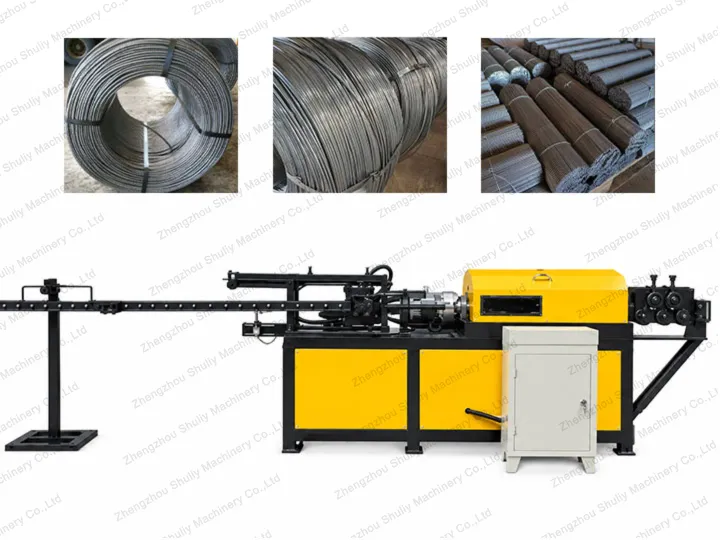
Steel Bar Straightening and Cutting Machine | Rebar Straightener and Cutter
상표: 슈리
기능: Straightening and Cutting
Cutting Diameter: 4–14 mm
Cutting Tolerance: ±1 cm
Cutting Speed: 40 - 100 m/min
Final Length: Adjustable
전압: 380 V, 50 Hz (Customization)
슈리 CNC rebar straightening and cutting machine is an integrated steel bar processing system that straightens coiled or reeled rebar and cuts it to precise lengths in a single pass. It processes 4-14 mm coiled rebar (round bar, ribbed bar, and wire rod) at speeds from 40 to 100 m/min, with cutting accuracy of ±1 cm.
Our steel bar straightening cutting machine replaces the traditional two-step process of manual straightening followed by separate cutting — saving labor, reducing waste, and delivering consistent bar quality.
This pillar guide covers the 3 machine series, 3 design features that set them apart from basic straighteners, compatible materials, real-world applications, and the data you need to pick the right model for your operation — whether you run a small construction site or a high-throughput precast plant.
Why Construction Sites and Rebar Plants Choose a CNC Rebar Straightener and Cutter
Coiled rebar arrives on site in rolls — bent, curved, and cut to no specific length. Before it can be used in beams, columns, slabs, or pile cages, it must be straightened and cut to exact dimensions. A CNC rebar straightening and cutting machine handles both jobs in one continuous operation:
- Construction site rebar preparation: Straightening 4-12 mm coiled rebar into cut-to-length bars for column ties, beam reinforcement, and slab mesh — replacing 2-3 workers with one machine operator
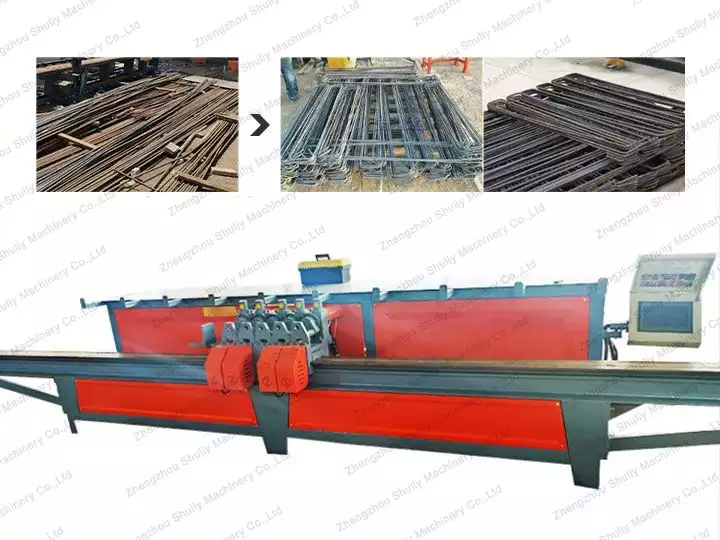
- Precast concrete plant feedstock: Producing consistent-length straight bars for automated cage welding lines, stirrup bending machines, and lattice girder production
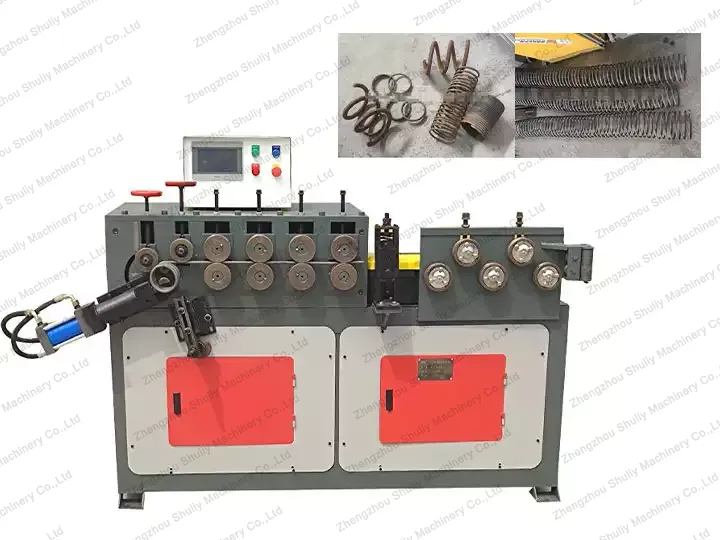
- Rebar processing center integration: Feeding a rebar cutting machine line or working alongside CNC spiral rebar bending machines for complete rebar processing
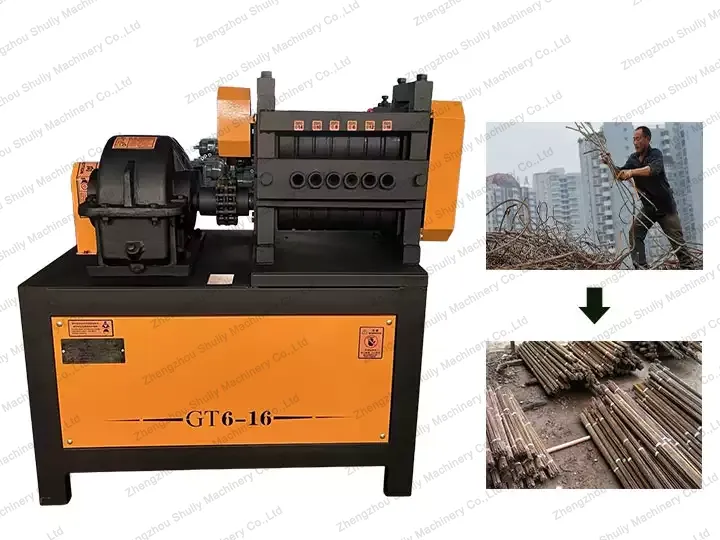
- Scrap rebar recovery: Straightening bent but usable scrap coiled rebar for reuse, reducing material waste and purchasing costs — complementary to a 철근 교정 기계를 스크랩하십시오
- Wire rod and mesh production: Processing 4-8 mm wire rod into straight lengths for welding into mesh panels, fence posts, and industrial wire products
- Bridge and highway reinforcement: High-volume production of precision-length bars for infrastructure projects where tolerance matters
All 8 models share three design features that separate them from basic manual straighteners and low-cost imports:
3 Design Features That Set Our CNC Rebar Straightening and Cutting Machine Apart
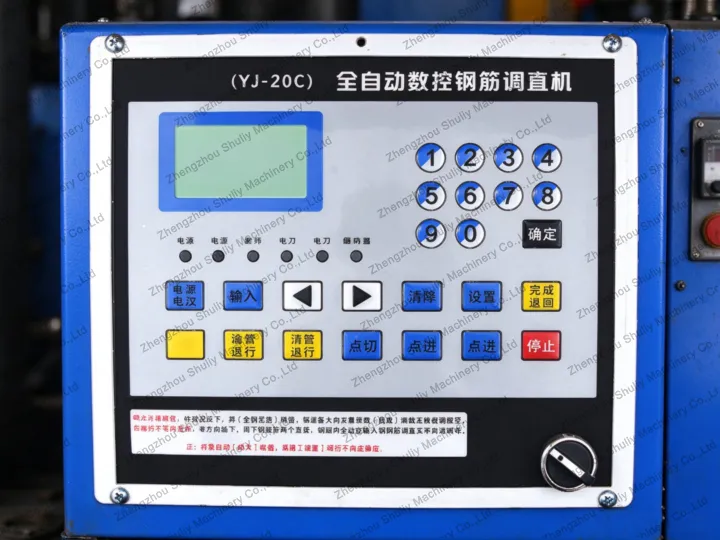
1. Multi-Function CNC Control Panel
Every model features an integrated CNC control panel that combines straightening speed adjustment, cutting length setting, batch counting, and fault diagnosis into one interface. The operator sets the desired bar length, batch quantity, and running speed on the panel — the machine handles the rest.
Unlike older machines that require manual dial adjustments and mechanical limit switches, the CNC panel stores presets for different bar diameters and lengths, cutting changeover time from 15 minutes to under 2 minutes.
This matters in real terms: a rebar processing plant switching between 8 mm bars for column ties and 12 mm bars for beam reinforcement can complete the changeover without stopping production.
On a construction site, the site foreman can program tomorrow’s bar schedule tonight and run it first thing in the morning with minimal supervision.
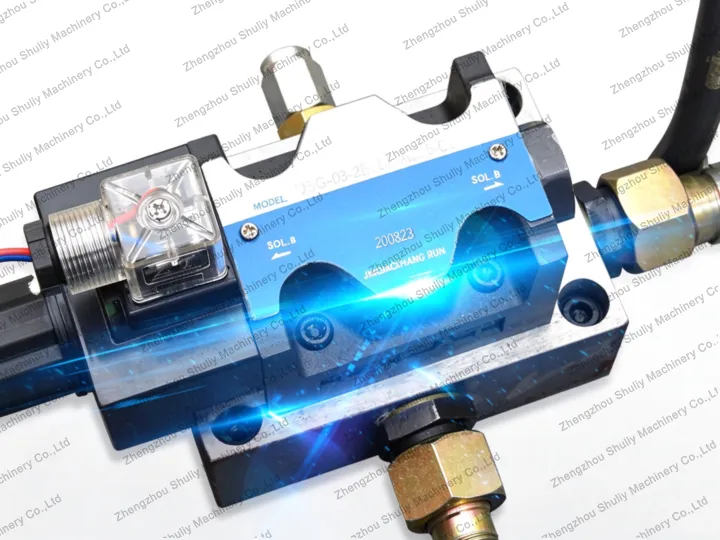
2. Premium Solenoid Valve with Imported Seals
The hydraulic cutting system uses a premium aluminum-body solenoid valve fitted with copper coils and imported seals. This combination solves the two most common failure modes in rebar straightening and cutting machines:
- External oil leakage eliminated: The aluminum valve body is machined to tighter tolerances than cast-iron alternatives, and the imported seals maintain their integrity under continuous 380V operation. On job sites where hydraulic oil drips contaminate the work area, this design keeps the machine clean and compliant.
- Internal leakage controlled: The copper coil generates a stronger, more stable magnetic field than aluminum-wire alternatives, ensuring the valve opens and closes fully on every cycle. Partial valve opening — the root cause of slow cutting and inconsistent bar ends — does not occur.
3. Chrome-Moly-Vanadium Alloy Measuring Wheel
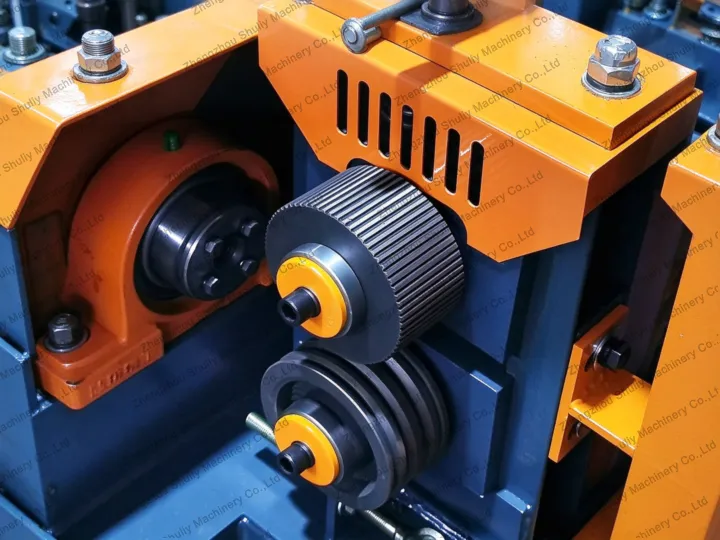
그만큼 measuring wheel (also called the counting wheel) is the component that tracks how much rebar has passed through the machine and triggers the cut at the programmed length. Ours is machined from chrome-moly-vanadium alloy steel — the same grade used in high-strength gears and shafts. This gives it two critical properties:
- Wear resistance: The measuring wheel contacts every meter of rebar that passes through the machine. A standard carbon-steel wheel wears a groove within 6-12 months of daily use, causing the measured length to drift. The chrome-moly-vanadium wheel maintains its diameter for 20,000+ tons of rebar, keeping cutting accuracy at ±1 cm throughout its service life.
- Counting precision: The V-groove profile grips the rebar surface without slipping, even on ribbed (deformed) bar. This ensures the machine’s digital counter accurately reflects the actual bar length — critical when you’re cutting 10,000+ bars per shift to the same specification.
Specifications of Rebar Straightening and Cutting Machine
The 8 models are organized based on traction type, speed class, and whether a material rack is included. All models share the same CNC control platform, solenoid valve, and chrome-moly-vanadium measuring wheel.
| Machine Pic | Specfications |
|---|---|
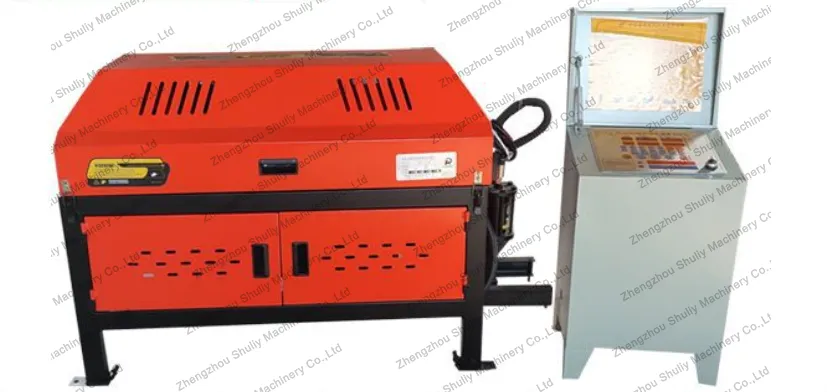 | Model: 4–12# Cutting diameter: 4–12 mm Cutting tolerance: ±1 cm Motor power: 7.5 kW Straightening speed: 40/min Voltage: 380 V, 50 Hz Dimensions: 152×58×94 cm Machine weight: 240 kg |
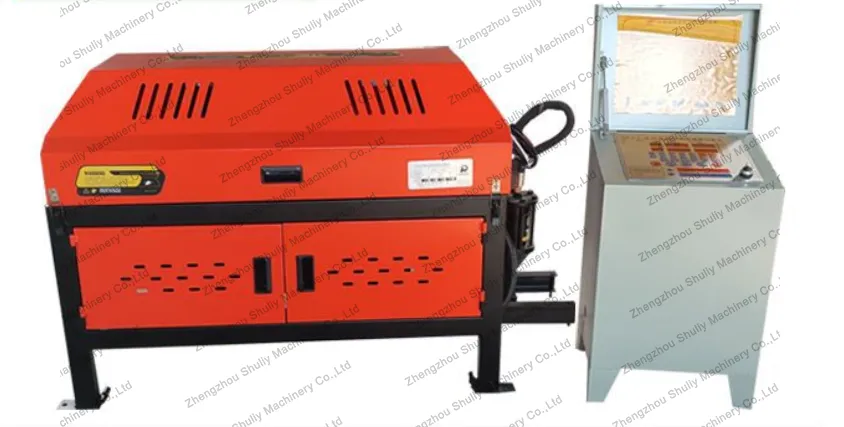 | Model: 4–12# Cutting diameter: 4–12 mm Cutting tolerance: ±1 cm Motor power: 9 kW Straightening speed: 45/min Voltage: 380 V, 50 Hz Dimensions: 168×60×98 cm Machine weight: 290 kg |
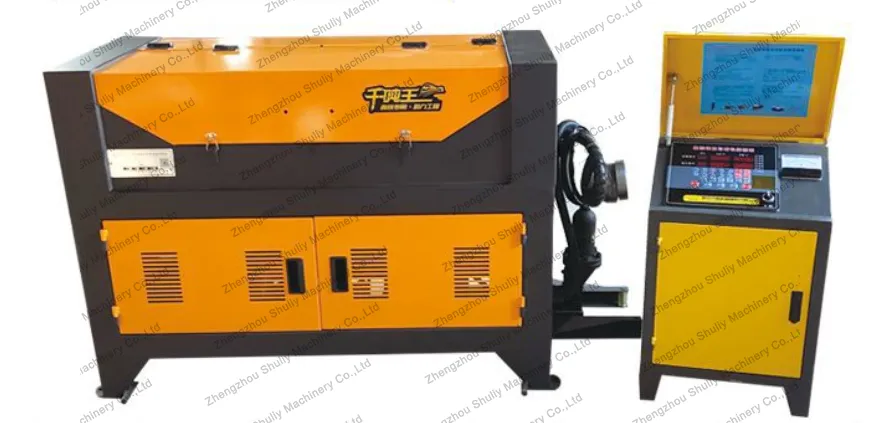 | Model: 4–12# Cutting diameter: 4–12 mm Cutting tolerance:±1 cm Motor power: 9 kW Straightening speed: 50/min Voltage: 380 V, 50 Hz Dimensions: 135×60×100 cm Machine weight: 340 kg |
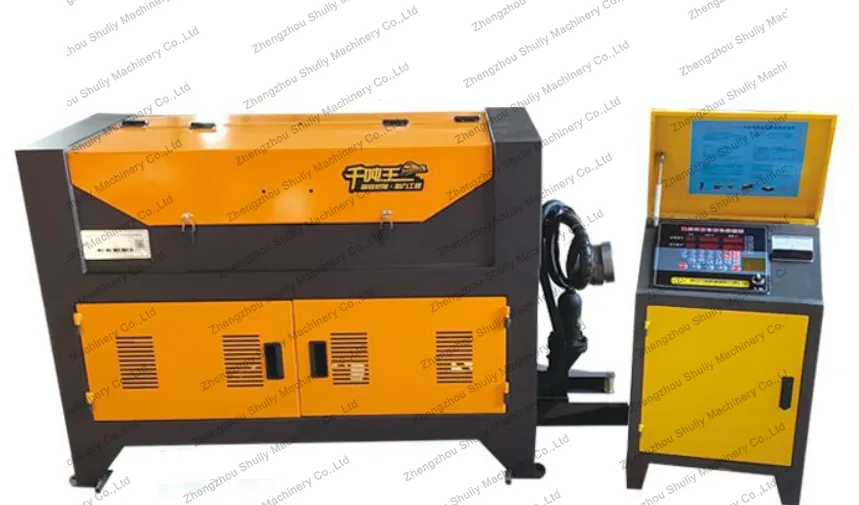 | Model: 4–14# Cutting diameter: 4–14 mm Cutting tolerance:±1 cm Motor power: 11 kW Straightening speed: 55/min Voltage: 380 V, 50 Hz Dimensions: 155×65×130 cm Machine weight: 390 kg |
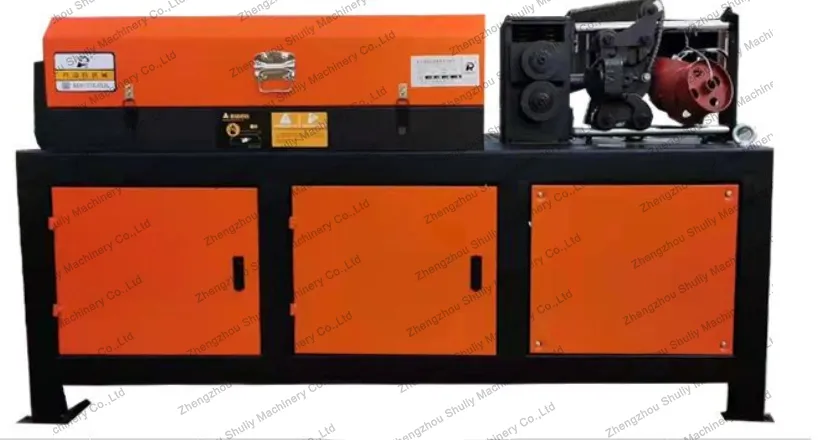 | Model: 4-12# (includes 8m material rack) Type: Single-traction Cutting diameter: 4–13 mm Cutting tolerance: ±1 cm Motor power: 9 kW Straightening speed: 50/min Voltage: 380 V, 50 Hz Dimensions: 190×65×110 cm Machine weight: 370 kg |
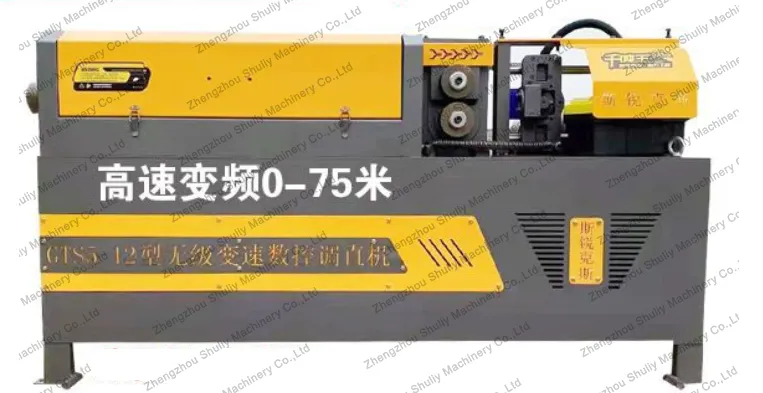 | Model: 5-12# (with 8m material rack) Type: Variable-frequency single-traction Cutting diameter: 4–12 mm Cutting tolerance: ±1 cm Motor power: 16.5 kW Straightening speed: 75 m/min Voltage: 380 V, 50 Hz Dimensions: 210×60×110 cm Machine weight: 700 kg |
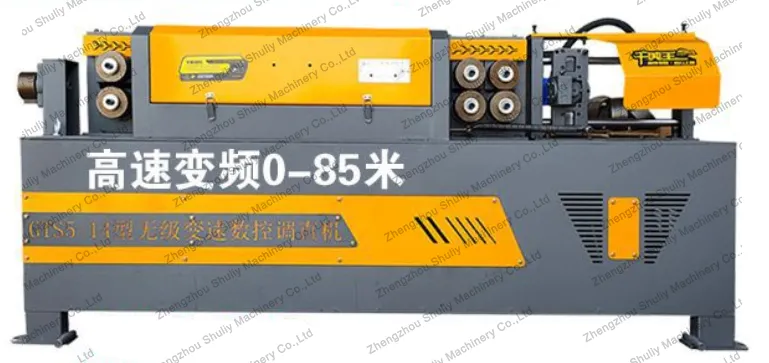 | Model: 5-14# (with 8m material rack) Type: Variable-frequency dual-traction Cutting diameter: 5–14 mm Cutting tolerance: ±1 cm Motor power: 20.5 kW Straightening speed: 85/min Voltage: 380 V, 50 Hz Dimensions: 240×70×115 cm Machine weight: 880 kg |
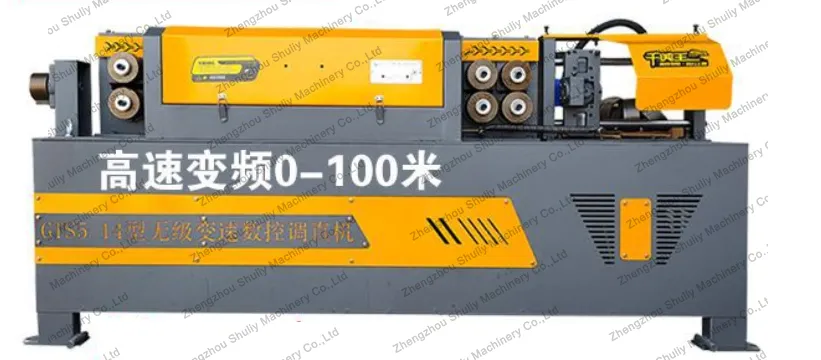 | Model: 5-14# (with 8m material rack) Type: Variable-frequency dual-traction system Cutting diameter: 5–14 mm Cutting tolerance: ±1 cm Motor power: 20.5 kW Straightening speed: 100 m/min Voltage: 380 V, 50 Hz Dimensions: 250×75×120 cm Machine weight: 1030 kg |
Compatible Materials for Rebar Straightener and Cutter
The CNC rebar straightening and cutting machine processes any coiled steel product within its diameter range. Here is what each material type looks like in practice:
| Material | Standard | Diameter Range | Typical Use After Processing |
|---|---|---|---|
| Coiled round bar | Q235, Q195 | 4-14 mm | Column ties, stirrups, mesh wire |
| Coiled ribbed (deformed) bar | HRB400, HRB500 | 5-14 mm | Beam reinforcement, slab bars |
| Wire rod | SAE 1006-1018 | 4-12 mm | Wire mesh, fence posts, nail stock |
| Cold-drawn rebar | CRB550 | 4-12 mm | Precast slab reinforcement, welded mesh |
Note: Ribbed bar above 12 mm should use the 4-14 or VFD dual-traction models. The deeper ribs on deformed bar require a stronger traction force to prevent slippage during measurement. For wire rod thinner than 5 mm, the standard series models provide gentler traction that avoids over-stretching.
How It Works: From Coil to Cut Bar in One Pass
Understanding the process flow helps you see why a CNC rebar straightening and cutting machine replaces multiple machines and operators:
- Step 1 — Coil loading: The coiled rebar is placed on the material rack (or a simple coil holder for standard models). The free end is fed into the machine’s entry guide.
- Step 2 — Traction and straightening: The traction rollers grip the rebar and pull it through the straightening unit. The straightening unit consists of multiple offset rollers (typically 5-7) that progressively bend the rebar in alternating directions, removing all curvature and coil memory.
- Step 3 — Length measurement: The straightened rebar passes over the chrome-moly-vanadium measuring wheel, which rotates in sync with the bar movement. The CNC panel reads the wheel’s rotation count and calculates the exact length traveled.
- Step 4 — Automatic cutting: When the measured length matches the programmed value, the CNC panel triggers the solenoid valve, which activates the hydraulic cutter. The bar is sheared cleanly at the exit point.
- Step 5 — Batch counting and discharge: The cut bar drops onto the discharge rack. The CNC panel increments the batch counter. When the preset quantity is reached, the machine stops automatically — the operator collects the bars and starts the next batch.
The entire cycle — from coil feed to cut bar — runs continuously at 40-100 m/min depending on the model. At 50 m/min on a 1-meter bar length, the machine produces roughly 50 bars per minute, or 3,000 bars per 8-hour shift with a single operator.
CNC Automatic vs Manual Rebar Straightening: Which Do You Need?
Buyers often ask whether they need a CNC automatic machine or whether a simpler manual straightener will suffice. Here is a direct comparison:
| Factor | CNC Automatic (This Machine) | Manual / Semi-Auto Straightener |
|---|---|---|
| Operation | One operator, CNC panel control | 2-3 workers, manual feed and measurement |
| 속도 | 40-100 m/min | 5-15 m/min |
| Cutting accuracy | ±1 cm (machine-controlled) | ±3-5 cm (operator-dependent) |
| Length changeover | Under 2 minutes (panel preset) | 10-15 minutes (mechanical adjustment) |
| Batch consistency | Identical bars across 10,000+ pieces | Drift after 200-500 pieces (fatigue) |
| Labor cost | 1 operator | 2-3 operators |
| Best for | Rebar plants, large sites, precast | Small sites, occasional use, budget constraints |
If you process more than 500 bars per day or need consistent length across multiple batches, the CNC machine pays for itself within the first month through labor savings alone. For occasional use on a small residential site, a manual rebar straightening machine may be sufficient.
CNC Rebar Straightening and Cutting Machine Price
The price of a CNC rebar straightening and cutting machine ranges from $3,000 to $10,000, depending on the model series, motor power, traction type, and optional accessories. Below is a breakdown by series:
- Standard Series 4-12mm: $3,000– 4,500
- Standard Series 4-14mm: $4,000– 5,500
- Rack-Mounted Series 4-12mm: $4,500– 6,000
- VFD High-Speed Series 5-12mm: $6,000–7,500
- VFD High-Speed Series 5-14mm: $7,500–10,000
Factors That Affect the Price
- 모터 파워: Higher kW motors cost more — a 7.5 kW entry model is significantly cheaper than a 20.5 kW VFD dual-traction unit.
- VFD (variable frequency drive): VFD models add 1 , 500– 2,500 over equivalent non-VFD models. The VFD pays back through speed flexibility, soft-start protection, and reduced mechanical wear.
- Material rack: Adding the 8m material rack increases the price by 300– 500. It is standard on VFD models and optional on standard models.
- Dual vs single traction: Dual-traction models use two sets of feed rollers for firmer grip on larger rebar, adding 500– 800 over single-traction equivalents.
- 전압 커스터마이징: Standard 380V/50Hz is included. Custom voltage (220V/415V/480V/60Hz) adds 200– 500 for transformer and wiring modifications
ROI perspective: A standard series machine at 3, 000– 4,500 replaces 2-3 manual workers. At an average labor cost of 500– 800/month per worker in Southeast Asia, Africa, or South America, the machine pays for itself within 2–4 months. VFD models at higher throughput shorten the payback period further for high-volume operations.
Maintenance Guide — Keep Your Machine Running for Years
The CNC rebar straightening and cutting machine is designed for low maintenance, but a few routine checks extend service life significantly:
- Daily: Clean metal debris from the straightening rollers and measuring wheel. Check hydraulic oil level. Wipe the CNC panel screen.
- Weekly: Lubricate the traction roller bearings and straightening roller shafts with grease. Inspect the cutting blade for wear — a dull blade produces ragged cuts and puts extra load on the solenoid valve.
- Monthly: Check the solenoid valve seals for any signs of weeping. Inspect the measuring wheel V-groove for wear (replace if the groove is visibly flattened). Verify cutting accuracy by measuring 10 random bars from a batch.
- Every 6 months: Replace hydraulic oil (use ISO VG 46 or equivalent). Check all electrical connections for tightness. Inspect the VFD cooling fan (on VFD models) and clean the air filter.
Related Rebar Processing Equipment
- Rebar Cutting Machine — For cutting straight stock rebar (not coiled) to length. GQ series, 8 models covering 4-50 mm. Use alongside this machine when you also process straight stock bar.
- Scrap Rebar Straightening Machine — For straightening bent scrap rebar (not coiled) for reuse. Different purpose: this machine handles coiled rebar; the scrap straightener handles deformed used bar.
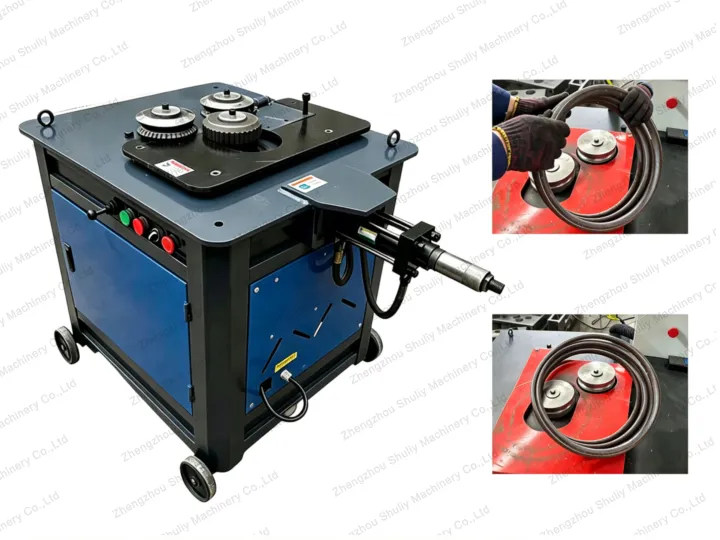
- CNC Spiral Rebar Bending Machine — For forming spiral hoops and circular rings from straightened bar. Feed the output of this machine directly into the spiral bender.
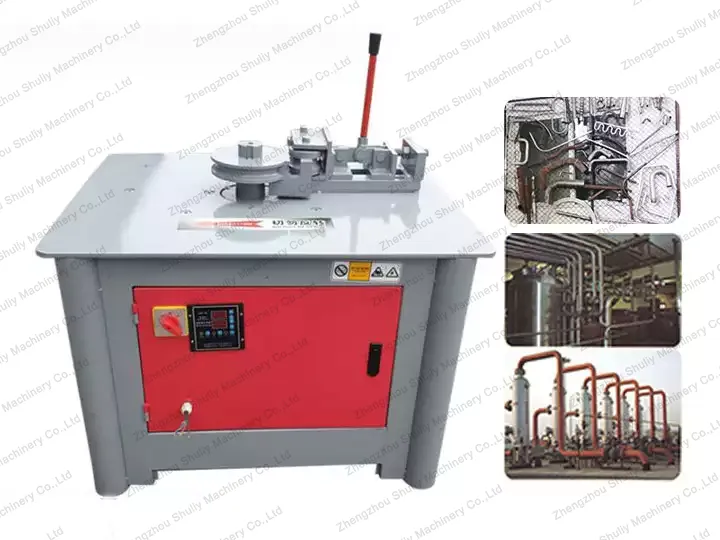
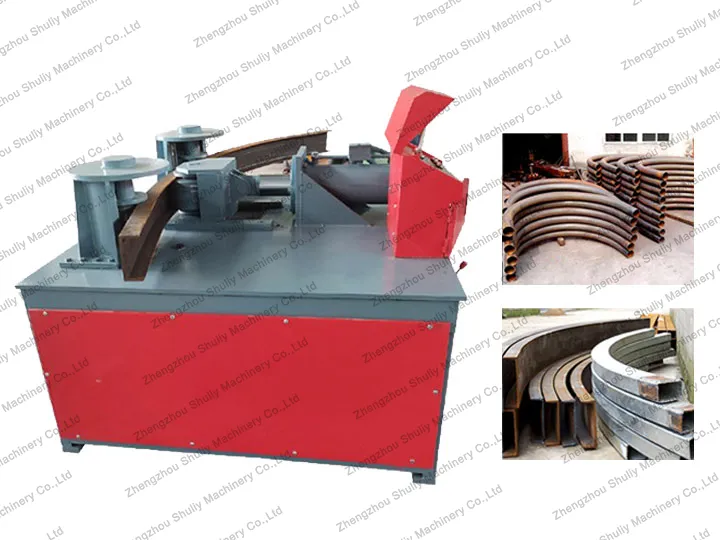
- Rebar Arc Bending Machine — For bending straightened bars into circles, arcs, and curves for pile cages and structural components.
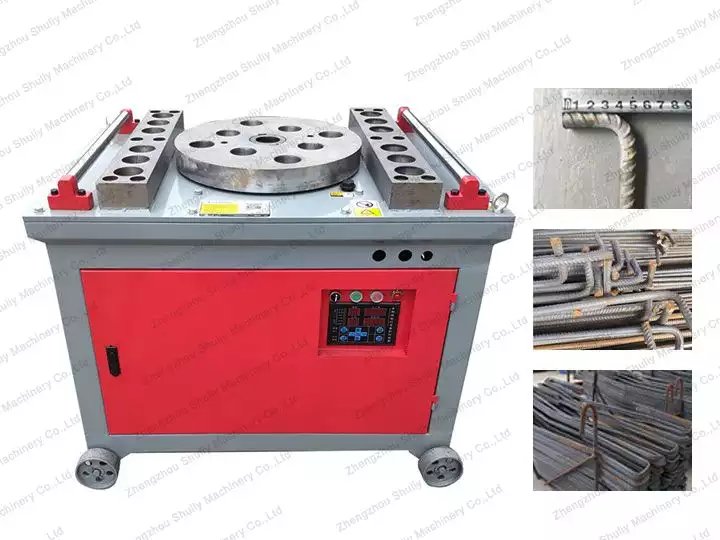
- Steel Bar Bending Machine — CNC-controlled bender for general-purpose rebar bending angles and shapes.
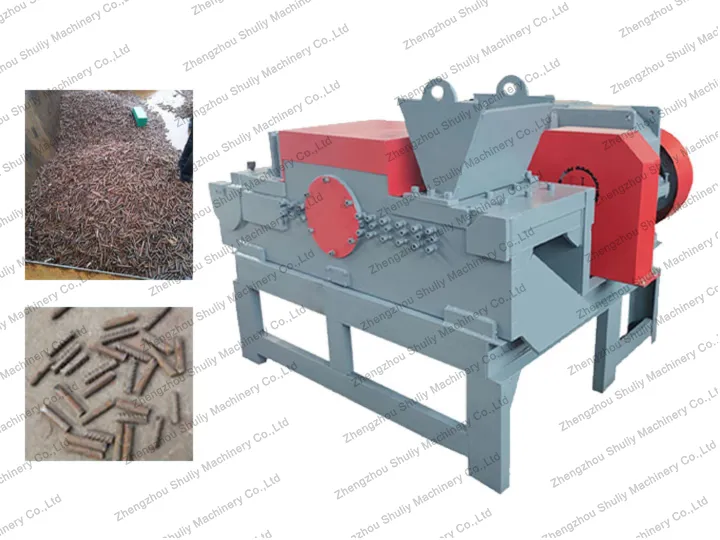
- Scrap Rebar Granulator — For chopping scrap rebar ends and offcuts into furnace-ready pellets. Process the waste from your straightening and cutting operation.
FAQ of Rebar Straightening and Cutting Machine for Sale
What is the difference between a rebar straightening and cutting machine and a wire straightening machine?
A rebar straightening and cutting machine handles thicker steel bars (4-14 mm) with higher traction force and a hydraulic cutting system.
A wire straightening machine is optimized for thinner wire (0.5-4 mm) with lighter rollers and a mechanical shear.
What diameter rebar can this machine process?
The 8 models cover 4-14 mm in total.
Can the machine process ribbed (deformed) rebar?
Yes. All models process both round (smooth) bar and ribbed (deformed) bar within their diameter range.
What voltage does the machine require?
Standard voltage is 380V / 50Hz, 3-phase. We can customize to 220V, 415V, 480V, or 60Hz for your local power supply. Please specify your voltage requirements when ordering.
How do I choose the right rebar straightening and cutting machine?
The right machine should be selected according to the customer’s actual production requirements. The most important factors are:
Rebar diameter: What is the minimum and maximum diameter?
Rebar type: Round steel, deformed rebar, or both?
Cutting length: What finished lengths are required?
Production capacity: How many meters or tons need to be processed per hour or day?
Power supply: What voltage, frequency, and phase are available?
Automation level: Manual, semi-automatic, or fully automatic operation?
Providing these specifications to the manufacturer is the easiest way to select a suitable model.
How many bars can the machine produce per hour?
Output depends on bar length and model speed. At 50 m/min cutting a 1-meter bar, a standard model produces about 50 bars per minute (3,000 per 8-hour shift). The VFD 100 m/min model doubles this to approximately 100 bars per minute (6,000 per shift).
What are the main wearing parts and maintenance requirements?
The main wearing parts usually include straightening rollers, feeding rollers, cutting blades, bearings, belts, and other transmission components.
Get a Quote — Tell Us Your Requirements
To recommend the right model, we need to know:
- What diameter rebar do you process most often?
- What is your daily or shift output target (number of bars)?
- What is your local voltage (380V/220V/415V/480V, 50Hz/60Hz)?
- Do you need a material rack for unattended operation?
Contact Shuliy with your requirements and we will provide a detailed quotation within 24 hours, including model recommendation, FOB/CIF pricing, and delivery timeline.
왓츠앱: +86 136 7368 9272 이메일: info@baler-machines.com
A CNC rebar straightening and cutting machine is often part of a complete rebar processing line. Here are complementary machines in our product range: